

The job just got a name.
I have been doing it for fifteen years.
They are calling it a marketing engineer: the person who turns market signal into pipeline using agents, data and judgment, and builds a marketing system that keeps learning. It is about to be one of the most valuable roles in business. I have been doing that job since 2009, across seventy companies, and I kept every file.
15+ years · 70+ companies · 60+ seven-figure builds · $1.2B+ in client results
"You proved again and again that I was overcomplicating, misdiagnosing my problems, and always trying to solve them with a marketing tactic instead of good ole simplicity." Joe Giglietti, Multiply Inc.
You came here thinking you have a marketing problem.
You probably don't. Not really.
Most founders I meet aren't short on effort, budget, or ideas. They're drowning in them. Half-built funnels, three offers, a list of tactics, and no clear plan holding any of it together.
And in the last two years that got considerably worse.
Execution used to be the expensive part. It isn't any more. So the founders I meet now are not sitting on three half-finished initiatives. They are sitting on thirty. More funnels, more angles, more variants, more content, all of it cheap and fast and none of it chosen.
The dashboard has never been fuller.
Point a machine at the wrong constraint and it just gets you there faster.
The problem is not your work rate, and it was never your work rate. The problem is that nobody has told you which single thing matters most right now, and given you permission to drop the rest.
See how many of these you can tick.
- Revenue is real, but it stopped compounding a while ago.
- You are the bottleneck. Every decision still routes through you.
- You bought the tools. Output went up. The number that matters did not.
- There are half-finished initiatives you feel guilty about, and you have lost count.
- Your follow-up is buried somewhere, and you know there is money in it.
- You have hired help before and ended up managing them.
- You could not say, in one sentence, what the single most important thing is this quarter.
Three or more, and we should talk. That pattern is the one I have spent fifteen years taking apart.
There is finally a name for the thing I do.
For fifteen years the honest answer to "what do you actually do" took me a paragraph. Launch manager. Sales and marketing systems architect. Growth partner. None of them landed, because the job was always the same and the labels kept missing it.
The industry has now settled on one: marketing engineer. The person who turns market signal into pipeline using agents, data and judgment, and who builds a marketing system that keeps learning instead of starting from zero every Monday.
The people naming it think it becomes one of the most valuable roles in business over the next two years, at $250,000 to a million a year for the ones who can genuinely do it. I think they are right, and I think the number tells you something about the scarcity rather than about me.
Because here is the part that gets skipped. A marketing engineer still needs everything the job always needed: customer understanding, positioning, distribution, judgment, taste. The machines did not remove any of that. They removed the excuse.
"Taste matters more now than ever, because AI is about to make average marketing unbelievably cheap." On the rise of the marketing engineer
The agents are becoming a commodity. What you point them at is not.
Everyone now has a machine that will write the funnel for them. Everyone has the same models, roughly the same prompts, and a great deal more output than they had two years ago.
Almost nobody has fifteen years of dated records showing which funnels actually worked, and which ones quietly did not.
That part does not come out of a model. It is the actual thing I bring to your business.
You can buy the tools this afternoon. You cannot buy the seventy companies it took to learn where the money hides, and you cannot buy the autopsies, which are the half nobody publishes.
When you walk me through your business I am not being clever, and I am not brainstorming. I am recognising something I have seen before, and telling you which part actually matters.
That is the one thing that has got more valuable in the last two years, not less.
I was doing this when it was just called doing the work properly.
Three files out of the archive. Read them with the new job title in your head.


Instrumented testing. A system diagram. A spec with dependencies and timing. That was engineering in 2013 and it is engineering now.
The only thing that changed is that the machines got good enough to run the parts I used to do by hand.
Which is good news for you, and it is why a founder in 2026 can get in ninety days what used to take a year.
Let's start with this year, not 2010.
Anyone can show you a decade-old screenshot. Here is a live client scoreboard from this year, month by month.
January through August of this year. Eight months in a row, tracked monthly, not a highlight cherry-picked from a good quarter. That is the actual sheet, not a redraw of it.
The archive underneath this goes back fifteen years and it is further down the page if you want it. But I would rather you judged me on what is happening now.
Open full size to read every row
Three moves. In this order. Every time.
This is not a framework I invented for a landing page. It is the actual sequence, and the order matters more than any individual step. Every move is backed by data.
Find your one clear path
You walk me through the business. We work backwards, past the tactic you came in worried about, to the root. Usually there is more than one, and usually it is not where you are looking.
This is the step no machine does for you, because it requires deciding what matters, and deciding is not a retrieval problem.
You end up with: the single constraint named, the path through it mapped, and the list of things you are now allowed to stop doing.
Remove the ridiculous
We cut. Half-built funnels, offers that confuse the market, reporting nobody reads, the tool you bought in February, the hire you made to manage a problem that shouldn't exist.
Simple is not the same as sloppy. Everything that stays has to earn its place, and now that anyone can generate anything, that filter is the whole job.
You end up with: fewer moving parts, a shorter week, a business a stranger could understand in five minutes, and results that compound.
Stay the course
This is the one everybody skips. The path only pays if you walk it long enough for compounding to show up. I stay in it with you, week after week, so the plan survives contact with a busy month.
You end up with: an operator who doesn't disappear after the fancy strategy fades and the lack of results burns another hole in your wallet.
Most coaches and consultants sell you step one and leave. The money for you is in step three.
A system that keeps learning, and it stays in your business.
Most companies use these tools in scattered chats, so every lesson evaporates the moment the window closes. The performance data, your actual voice, the objections from sales calls, the language that got replies: none of it is anywhere a person or a machine can reach next week.
So the first thing we build is your marketing memory, in plain files you own.
Every job gets a data source, a schedule, filters, an expected output, the point where it needs your approval, and the metric it answers to. The same discipline you would apply to a person joining the team.
And it writes results back, so next quarter starts smarter than this one instead of starting again.
This is not a new idea for me. Here is the folder structure out of the archive, from years before anyone called it a growth repo.
Activity counts are how people feel busy. I run by the numbers, and so should you.
Your first six months, honestly.
No two businesses run the same, so treat this as shape rather than schedule. But this is the rhythm of nearly every engagement I have run.
The teardown
You walk me through everything: numbers, offers, funnel, team, calendar. I am not brainstorming. I am pattern-matching against fifteen years of files. You get the one-page diagnosis at the end of it.
The cut, and the first build
The stop-doing list is actioned, not just written. One revenue mechanism is chosen and under construction. Usually that is follow-up, confusing messaging, or sloppy offers, because that is where the buried money almost always sits.
Something is measurably working
The first mechanism is live and producing numbers we can both see on a scoreboard. This isn't a guessing game. This is business.
It compounds without heroics
The mechanism runs on a cadence rather than on your adrenaline, and the system knows more than it did in month one. Your week looks different, which is usually the change founders notice before the revenue.
I don't sell seats. I take a position in your business.
A handful of founders at a time. Structured so I only do well if you do well.
Most advisors bill you whether anything improves or not. I have never liked that, and it attracts the wrong kind of client.
So I don't work on a flat fee. I take a position. Part of what I earn is tied directly to the profit we build together, and to what the business is worth if you ever sell it. You keep every share you own, and I carry real downside if I get this wrong.
I don't put the numbers on a web page, because a $2M business and a $10M business are not the same conversation. What I will tell you is that most of what I earn depends on your business being worth more than it was when I arrived.
This is a bad idea for most people.
I would rather lose you here than waste a call for both of us.
Worth a conversation
- The business is established and already profitable. Revenue should be high six figures, otherwise this is probably not the right time.
- You built it and you still run it.
- You are the constraint, and you know it.
- You have more output than you have ever had, and no more revenue.
- You want fewer things done properly, not more things attempted.
- You can make a decision without a committee.
Not for you
- Pre-revenue, or an idea you are validating.
- A business in genuine trouble looking for a rescue. I am not a turnaround.
- You want a course, a portal, or 47 modules of homework.
- You want a tool recommendation and a prompt pack.
- You want someone to execute while you stay out of it.
- You are shopping for the cheapest version of this.
Now the fifteen years, if you want it.
Dated. Timestamped. Ugly in places, because real files are. Names blacked out, numbers untouched.
This is not nostalgia, and it is not a highlight reel. It is a record of what worked and what did not across businesses that had nothing to do with each other. That record is the thing I point the machines at, and it is the reason they hit something.
A client came to me with deep expertise and no launch. That is the actual post-launch report, black marker and all. He went on to a $1 million run inside 14 months, and a $5 million business inside 32. Then he came back and paid me $20K a month for ongoing advisory. One launch is a spike. What I actually build is the engine underneath it.


$104,580 in 72 hours. Dates on screen. And Exhibit 03, from 2011: $236,546 in expected subscription income across six months, booked recurring revenue from one client's product suite.
Anyone can look good for a quarter.
An ebook we built at the very beginning. Ten years later, unprompted, it was on his wall, and Facebook embedded the original 2014 post underneath the photo. A double timestamp I could not fake if I tried. Today Rob's company manages over $540M in combined annual revenue.


Not everything fits in a screenshot.
Different industries, same pattern. Because the machine does not care what you sell. It cares that you have buyers, an offer, and follow-up.
Sheep farmers don't buy hype. They bought a positioned system. 5x.
No launch. No hype. A lead machine, built once, doubling sales year after year.
The engine outlived the launches. That was the point.
Forex. Sheep. Duplexes. Events. Education. The industries never match. The pattern always does. Which is the point: yours won't be special either. That is good news.
"From losing $5k/month when we first talked, we hit $72,000 in the first 30 days, $794K in the first year, and we'll hit $5M in 24 months. Is there anything else I need to say?"
"We did three 6-figure launches in the last year which has transformed my business financially and doubled my income. He's also shown me better ways to attract, retain and work with my clients."
"James is a brilliant marketer who cuts through the chaff. More money in less time is right. One strategy I learned doubled my income in less than 30 days. He's the real deal."
"James Klobasa made me money. We hit six figures in less than 24 hours. What really matters is that he knows what he's doing. And it converts."
"Multiple six figure launches one after another, from the very first that took place in 5 days. Awesome."
"I didn't know the level of detail and care that James brings even existed. He listened to everything I wanted, not just for my business, but my life plan, and created strategy-based feedback that blew my mind."
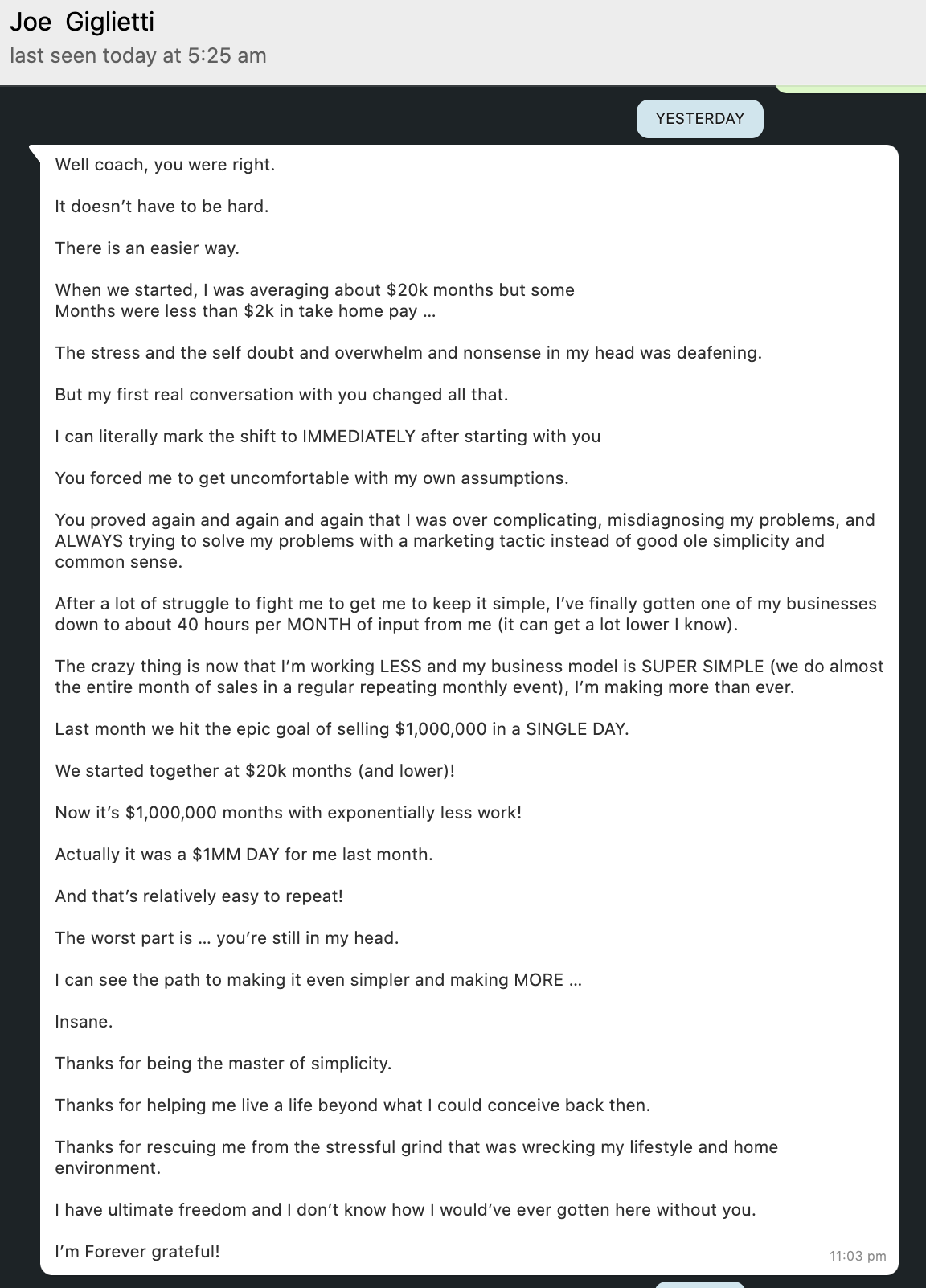
One client put it better than I can.
This is the actual message, unedited. Read the whole thing, especially the line about a million dollars in a single day, and the one about working forty hours a month.
When Joe and I started, he was months from losing everything. Take-home some months was under $2K. In his words, "the stress and the self doubt and overwhelm and nonsense in my head was deafening."
Joe was nearly homeless when we started. That is his house now, shared with his blessing. I am not promising you Joe's outcome. He did the work, and outcomes like his are not typical of anything. I am showing you what happens when a founder finally gets clear, cuts the noise, and stays with it.
I don't want to be the star. My skill is making them.
Twelve years in professional sport, then a hard landing in business. A few years of no results at all. So I went back to study: copywriting, direct response, launch management, positioning.
The work started paying in 2009, right after the worst year of my life. Six-figure launches, then seven-figure builds, then the advisory work. Since then I have been inside 70+ companies and their launches, funnels and campaigns. The wins and the autopsies.
That is the honest mechanism. When you walk me through your business, I am not being clever. I am recognising something I have seen before, and telling you which part actually matters.
That is the one thing that has got more valuable in the last two years, not less.
On the panel at Jeff Walker's Product Launch Formula. That banner behind me is the job description I have had for fifteen years. It just took the industry until now to give it a shorter name.
Marketing engineer.
Based on the Sunshine Coast, Australia. Working with founders worldwide.
The questions you're already asking.
Can't I just do this with AI?
You can do the doing with AI. That was never what you were short of.
Execution is close to free now, which is exactly why the founders I meet are not drowning in three half-built initiatives any more. They are drowning in thirty. The dashboard is fuller than it has ever been.
The constraint was never your work rate. It was that nobody had named the one thing that matters right now and given you permission to drop the rest. Point a machine at the wrong constraint and it just gets you there faster.
So do you just run my AI tools for me?
No. I take a position in the business and build the growth system, and the agents are one part of how the work gets done rather than the point of it. If all you want is someone to configure tools, you want a contractor and you will be able to find one cheaper than me.
What does it cost?
It depends on the size and shape of the business, and I am not going to pretend otherwise on a web page. Most of what I earn depends on your business being worth more than when I arrived. We put real numbers on it during the call, once I have seen yours.
What happens after I send the form?
I read it myself. If it looks like a fit, you get a reply within 48 hours with a couple of times for a call. If it does not, you still get a reply telling you why, and usually a pointer to what I would do in your position. Nobody gets left un-read.
How much of your time do I actually get?
A small number of clients at a time, so: real time. Weekly working sessions, and access between them. I am not running this through an account manager. You get me, which is the entire point of taking so few.
My industry is different.
Forex, sheep genetics, duplex development, live events, property education. The industries never match. The pattern always does. If yours turns out to be the genuine exception, you will know inside our first 30 minutes together.
I've been burned by consultants before.
Almost everyone I work with has. Usually by someone who sold a strategy and left before implementation. That is exactly why most of what I earn is tied to what we build together rather than to turning up. If nothing improves, I am the one who loses.
Is the call a sales pitch?
No, and you will be able to tell within ten minutes. I spend the time doing the thing I actually do, which is finding the constraint. If we are a fit I will say so and we will talk about what that looks like. If we are not, I will say that too, and you will still leave with the diagnosis.
One conversation. One clear path.
Forty-five minutes. No deck, no pitch, no homework.
- You walk me through the business. What it does, what it earns, and the thing you think is broken.
- I do what I do on day one of every engagement: work backwards, past the tactic, to the actual constraint.
- You leave with my read on the one thing holding growth right now, and what I would do about it first.
- You get that whether or not we ever work together.
If we are not a fit, I will tell you on the call, and you will still leave with the diagnosis. Send your name, your business, roughly what it turns over, and the one thing you think is broken.
Your name, your business, roughly what it turns over, and the one thing you think is broken.
This comes straight to me. I read every one myself and reply within 48 hours.
I only take a small number of these calls each month.
The drawer wouldn't close.
Messages, screenshots and moments that didn't fit the exhibits above. Unstaged and unpolished, straight off the wall and out of the inbox. Names blurred to protect the successful.
Six figure months cracked for the first time. $400K profit months. A client who paid cash for an apartment. And the one with no dollars in it at all, where after a single call a bloke's mum heard "I love you" for the first time in two years.


Fifteen years makes a lot of paper. Let's make yours the next one.
P.S. You have now seen fifteen years of my files. Here is what they taught me: the money is almost never where the founder is looking. That was true when I was split-testing pages by hand in 2011 and it is true now that a machine can build the whole funnel before lunch. This is not a course and it is not coaching. It is a partnership, with my money riding on the same outcome as yours.
P.P.S. In eighteen months every serious company will have someone doing this job. The ones who move first will have eighteen months of a system that has been learning, which the others cannot buy back at any price. If you are stuck and you know it, tell me about it. I read every message myself.
Earnings and income disclaimer. All testimonials and results on this page are from real clients, with dates and documents shown where possible. The results you see are not typical. These experiences do not guarantee similar results. Individual results vary based on your skills, experience, market, effort and other factors outside anyone's control. Results require work.
James Klobasa · Sunshine Coast, Australia · Working with founders worldwide